
Skilled nursing facility billing represents one of the most complex segments of the healthcare revenue cycle. Unlike standard outpatient or physician-based claims, reimbursement for skilled nursing facilities (SNFs) is governed by an intricate web of federal regulations, clinical assessments, and institutional constraints. Navigating these rules is a constant challenge for post-acute care providers. Where even a minor administrative oversight or a missing clinical assessment can trigger devastating claim denials or severe revenue leakage.
Is Your Facility Facing Complex Billing Hurdles?
Avoid revenue leakage and claim denials. Partner with AMS Solutions for 100% U.S.-based medical billing and expert RCM support tailored for skilled nursing environments.
For established long-term care facilities and skilled nursing operators, maintaining financial stability requires a deep, clinical understanding of Medicare guidelines, state-specific Medicaid rules, and managed care contracts. In this comprehensive guide, we will break down the essential components of skilled nursing facility billing. Specifically, we will analyze the critical operational mechanics of Medicare Part A and Part B coverage. Demystify consolidated billing, and provide actionable strategies to optimize your revenue cycle management (RCM).
What is Skilled Nursing Facility Billing?
At its core, SNF billing is the process of translating complex, multi-disciplinary clinical care into structured institutional claims for reimbursement. While physician billing focuses primarily on individual procedures and professional services, skilled nursing facility billing encompasses a comprehensive array of room-and-board. Nursing care, therapy services, medical supplies, and administrative services provided to residents in a post-hospital setting.
Because skilled nursing facilities serve a highly vulnerable patient population with diverse medical needs, their billing processes are tightly coupled with clinical assessments. The primary driver of SNF billing accuracy is the Minimum Data Set (MDS), a comprehensive clinical assessment tool that records a resident’s functional capabilities, medical diagnoses, and cognitive status. The data gathered via MDS assessments is not only vital for patient care planning but is also the direct foundation for determining reimbursement under federal payment models.
How Do Medicare Part A and Part B Billing Differ in SNFs?
The first major hurdle in managing a skilled nursing facility’s revenue cycle is correctly separating and processing services under Medicare Part A (Inpatient) and Medicare Part B (Outpatient/Ancillary). Under Medicare billing for SNF, these two programs operate on completely different payment methodologies, eligibility criteria, and documentation standards.
Medicare Part A: Skilled Inpatient Care
Medicare Part A covers up to 100 days of skilled nursing or rehabilitation care per “spell of illness” for beneficiaries who require daily skilled services. To qualify for Part A coverage, Medicare guidelines enforce a strict hospital stay requirement: the resident must have a prior. Qualifying inpatient hospital stay of at least three consecutive days (excluding the day of discharge). Additionally, the resident must be admitted to the SNF within 30 days of their hospital discharge for the same or a related condition.
Reimbursement under Part A is paid on a prospective, per-diem basis. This means the facility receives a single, bundled daily payment that must cover all room, board, nursing, therapy, medications, and ancillary services. The prospective payment rates are adjusted daily based on the resident’s clinical classification under the federal payment model.
Medicare Part B: Outpatient and Ancillary Services
Medicare Part B covers outpatient and ancillary services. This option can be utilized when a resident does not qualify for Medicare Part A (for instance. If they did not meet the prior 3-day hospital stay requirement) or has fully exhausted their 100 days of Part A coverage. Under Part B, billing professionals submit individual fee-for-service claims to reimburse specific medically necessary services, including:
- Outpatient physical, occupational, and speech-language therapy.
- Certain diagnostic services, such as portable X-rays and laboratory tests.
- Specific medical supplies and durable medical equipment (DME).
- Preventive services, vaccinations, and physician professional visits.
Unlike Part A’s bundled prospective rates, Medicare Part B typically reimburses 80% of the approved charges according to the Medicare Physician Fee Schedule (PFS). With the remaining 20% coinsurance being the responsibility of the resident or their secondary insurance provider.
| Feature | Medicare Part A (Inpatient) | Medicare Part B (Outpatient) |
|---|---|---|
| Eligibility Requirement | 3-day qualifying inpatient hospital stay within 30 days. | No prior hospital stay required; medically necessary services. |
| Coverage Window | Up to 100 days per “spell of illness” (Benefit Period). | No set day limit; based on ongoing medical necessity. |
| Payment Model | Bundled daily prospective payment (PDPM). | Fee-for-service according to the Physician Fee Schedule (PFS). |
| Financial Structure | Days 1-20: 100% covered. Days 21-100: Daily co-payment. | 80% Medicare covered, 20% patient co-insurance responsibility. |
What is the Patient-Driven Payment Model (PDPM)?
To succeed in skilled nursing facility billing, billing teams and clinical staff must align with the Patient-Driven Payment Model (PDPM). Implemented by the Centers for Medicare & Medicaid Services (CMS) in October 2019, PDPM completely transformed how Medicare Part A services are reimbursed. Shifting the payment mechanism away from the volume of therapy minutes provided toward a patient’s specific, documented clinical characteristics.
Under the old model (RUG-IV), facilities were financially incentivized to maximize therapy hours, which often resulted in over-utilization of therapy services. Under PDPM, Medicare assigns residents into specific case-mix groups based on their clinical diagnoses, cognitive levels, and functional needs. This shift places a massive premium on the accuracy of your clinical documentation and coding at admission, as these elements directly dictate your prospective reimbursement rates.
PDPM utilizes five distinct case-mix adjusted payment components to calculate a single daily rate, plus one non-case-mix adjusted component. Understanding these components is critical to preventing underpayments in medical billing:
- Physical Therapy (PT): Based on primary clinical reasons for the SNF stay and the resident’s baseline functional status.
- Occupational Therapy (OT): Determined by the primary diagnosis and functional status, mirroring the PT criteria but weighted differently.
- Speech-Language Pathology (SLP): Classified based on cognitive status, swallowing disorders, mechanically altered diets, and specific SLP-related comorbidities.
- Nursing: Calculated from the resident’s clinical conditions (such as extensive services, complex medical conditions, or rehabilitation needs) and functional status.
- Non-Therapy Ancillary (NTA): Based entirely on the presence of high-cost comorbidities and medical conditions (such as HIV/AIDS, parenteral feeding, or ventilators).
- Non-Case-Mix: A flat daily fee covering standard administrative and operational costs.
Because the daily rate is highly dependent on clinical diagnoses. Billing teams must collaborate closely with clinical coordinators to ensure that all active comorbidities are fully documented in the medical records and accurately captured on the 5-day MDS assessment. Failing to code a single qualifying comorbidity can result in a significant loss of potential daily revenue across a resident’s entire benefit period.
How Does SNF Consolidated Billing Work?
Perhaps the most challenging aspect of post-acute revenue cycle management is navigating the strict rules of consolidated billing. Implemented under the Balanced Budget Act of 1997, consolidated billing requires the skilled nursing facility to submit a single. Comprehensive claim to Medicare Part A or Part B for virtually all services a resident receives during their stay.
The primary intent of consolidated billing is to prevent duplicate billing (double-dipping) where both the SNF and an outside medical provider bill Medicare for the same service. Under these rules, if an SNF resident requires an service (such as physical therapy or a portable diagnostic test). The SNF must either provide the service directly using its own staff or arrange for an outside provider to deliver the service. If an outside provider is used, that provider cannot bill Medicare directly; instead, they must bill the SNF, and the SNF pays them according to their pre-negotiated arrangement.
Failing to understand consolidated billing boundaries is a primary cause of major compliance errors and financial disputes. If your billing team does not monitor external vendor services, outside providers may inadvertently bill Medicare directly. When Medicare detects this, they will deny the outside provider’s claim, and the outside provider will demand payment directly from your facility, often at non-contracted, premium rates.
Consolidated Billing Exclusions
While consolidated billing applies to almost all services, CMS maintains a specific, highly regulated list of excluded services. Excluded services are not bundled into the SNF’s prospective payment rate and can be billed directly to Medicare by the external provider. Common exclusions include:
- Physician professional services (including nurse practitioner and physician assistant visits).
- High-cost chemotherapy administration and specific customized chemotherapy drugs.
- Radioisotope services and specific high-cost outpatient surgical procedures.
- End-Stage Renal Disease (ESRD) services and kidney dialysis.
- Emergency ambulance transport (non-routine transportation remains bundled).
Your SNF billing department must keep a highly detailed, updated matrix of consolidated billing exclusions. Ensuring that your facility does not pay out-of-pocket for excluded services. While simultaneously blocking outside vendors from billing Medicare for included services, is vital to protecting your bottom line.
Common SNF Billing Codes and Claims Forms
In the administrative arena, skilled nursing facility billing relies on specific transactional standards and claims formats. Unlike outpatient clinics that submit claims on the professional CMS-1500 form, skilled nursing facilities submit their institutional claims using the UB-04 (CMS-1450) claim form (or its electronic equivalent, the 837I transaction).
To ensure clean claim submission, your billing team must master the unique fields on the UB-04 form, including.
- Type of Bill (TOB) Codes: A three-digit code indicating the type of facility, classification of care, and frequency of the bill. For skilled nursing facilities, the common codes are 21X (Part A inpatient claims) and 22X (Part B inpatient/outpatient claims).
- Revenue Codes: Four-digit codes that identify the specific accommodation, ancillary department, or billing category (for example, Revenue Code 0120 for room and board, or 0420 for physical therapy).
- HCPCS/CPT Codes: Specifically required on Part B claims to detail outpatient procedures, therapy interventions, and medical supplies.
- Value Codes and Occurrence Codes: Used to report specific numeric data and date-based events that affect Medicare payment. Such as Occurrence Code 22 to indicate the date of the qualifying hospital stay, or Value Code 50 to report the physical therapy unit count.
Actionable Strategies to Optimize Your SNF Revenue Cycle
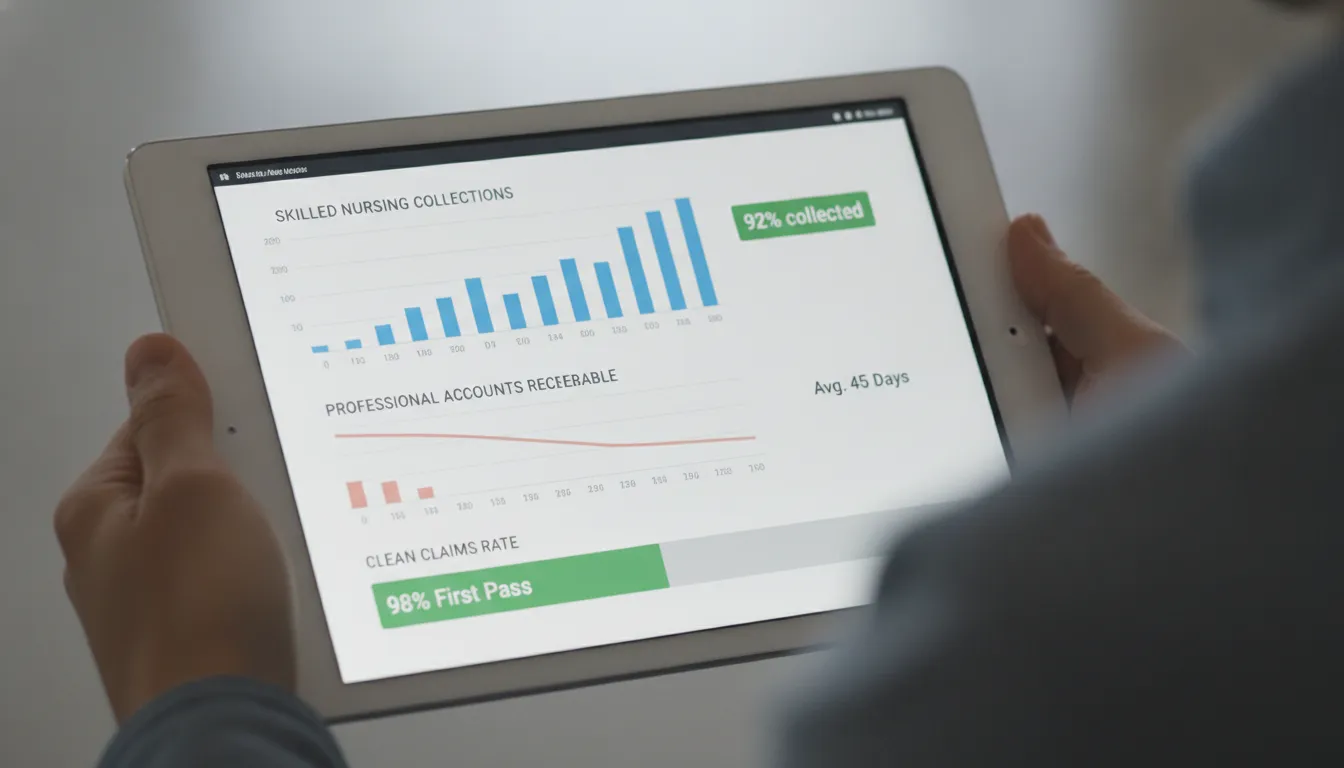
Operating a profitable skilled nursing facility requires moving from a reactive billing mindset to a proactive, integrated revenue cycle management strategy. Implementing the following operational guidelines can significantly reduce your days in accounts receivable (A/R) and drive clean claim rates upward.
1. Implement a Structured Triple-Check Process
The “Triple-Check” is the gold standard for SNF billing compliance. Prior to submitting the monthly claim, a cross-functional team consisting of the billing manager, MDS coordinator. And therapy director must meet to review every active Medicare Part A and Part B claim. The Triple-Check process must systematically verify:
- That the clinical diagnoses and comorbidities documented in the medical records perfectly match the ICD-10 codes billed on the UB-04 form.
- That the therapy minutes and units logged in the Electronic Health Record (EHR) exactly align with the billing codes and claims sheets.
- That the admission and discharge dates, qualifying hospital stay dates (Occurrence Code 22), and physician certifications are complete, signed, and structurally valid.
2. Standardize Eligibility and Authorization Workflows
Ineligible residents and missing prior authorizations are major contributors to SNF billing denials. Your intake team must perform exhaustive insurance verification prior to admission. This includes verifying the remaining benefit days under Medicare Part A and confirming the patient has not exhausted their 100-day limit. Additionally, your team must identify whether the resident has transitioned into a Medicare Advantage or commercial managed care plan. Which requires immediate, rigorous prior authorization and strict concurrent reviews.
3. Manage Accounts Receivable with Precision
Post-acute care claims frequently face delayed adjudication due to the complexity of the services provided. Your billing team must actively monitor your accounts aging reports, prioritizing outstanding claims at 30, 60, and 90 days. Dedicated account professionals should systematically follow up on all pending claims, research the root causes of claim denials. And coordinate immediate appeals with proper clinical documentation to recover every dollar of outstanding revenue.

4. Stay Compliant with CMS Guidelines
Federal and state billing regulations are in a constant state of flux. Your RCM team must continuously monitor updates to the Medicare Benefit Policy Manual and state-specific Medicaid guidelines. Investing in regular, formal billing education and compliance training for your administrative and clinical staff is the only way to prevent accidental compliance infractions. Audit penalties, and retroactive recoupments.
Optimize Your SNF Revenue Cycle Today
Stop leaving money on the table. Our dedicated, U.S.-based medical billing professionals ensure absolute compliance and maximized collections for your facility.
How AMS Solutions Optimizes Your SNF Revenue Cycle
Managing skilled nursing facility billing is highly specialized. It requires a level of expertise that most general billing agencies or resource-constrained teams comparing in-house vs outsourced medical billing simply cannot provide. For nearly four decades, AMS Solutions, Inc. has served as a premier, full-service medical billing and revenue cycle management provider, helping healthcare organizations maximize their collections while maintaining absolute compliance.
Our unique physician heritage, founded by doctors in 1986, means we understand your clinical workflows. The vital importance of medical billing compliance, and the direct connection between financial stability and quality care. We do not utilize offshore resources. Our operations, billing professionals, and account managers are 100% U.S.-based, ensuring the highest standards of data security, seamless communication, and active quality control.
At AMS Solutions, we believe in complete transparency and absolute alignment with our clients’ success.
- Seamless EHR Integration: We can integrate with any existing Electronic Health Record (EHR) software system, leveraging our documented compatibility with 26+ major medical software platforms to streamline your data capture.
- Simple, Transparent Economics: We operate on a flat percentage fee based on actual collections. There are no hidden fees, no initial setup costs, and absolutely no software expenses for your practice.
- Dedicated Account Experts: Your facility is assigned a dedicated account representative, providing a single point of contact for all your billing, credentialing, and collections needs.
- Established Performance: We serve established medical practices and facilities with at least $25,000 in monthly charge volume, delivering the stability, experience, and personalized service necessary to handle complex billing scenarios.
If you are ready to eliminate billing headaches, slash your claim denial rates. And optimize your skilled nursing facility’s revenue, partner with one of the most experienced RCM teams in the nation. Contact AMS Solutions today to receive a personalized pricing quote or to schedule a free, comprehensive consultation with our billing experts.
Frequently Asked Questions
How is skilled nursing billed?
Skilled nursing facility services are billed on institutional claims using the UB-04 (CMS-1450) form. Medicare Part A services are billed as a bundled daily prospective payment rate calculated under the Patient-Driven Payment Model (PDPM). Which relies heavily on patient clinical characteristics and active comorbidities. Medicare Part B and other ancillary services are billed on a fee-for-service basis according to the Medicare Physician Fee Schedule (PFS) using specific HCPCS and CPT codes.
What is the 3-day rule for SNF?
The 3-day rule is a strict requirement for Medicare Part A coverage in a skilled nursing facility. To qualify for Part A coverage, a beneficiary must have a prior, qualifying inpatient hospital stay of at least three consecutive days. The three days must be inpatient days and cannot include time spent in “observation status” or in the emergency room. Additionally, the resident must be admitted to the SNF within 30 days of hospital discharge.
How often will Medicare pay for a skilled nursing facility?
Under Medicare Part A, Medicare will cover up to 100 days of skilled nursing care per “spell of illness” (also known as a benefit period). The benefit period begins on the day the resident is admitted to the hospital or SNF and ends when they have not received any inpatient hospital or skilled care for 60 consecutive days. If a resident has a new spell of illness, a new 100-day benefit period can begin, provided they meet all qualifying criteria, including the prior 3-day hospital stay.
What is excluded from SNF consolidated billing?
Consolidated billing requires the SNF to bill for almost all services provided to its residents. However, CMS maintains specific, high-cost exclusions that are billed directly to Medicare by outside providers. Exclusions include physician professional services, End-Stage Renal Disease (ESRD) dialysis services, high-cost chemotherapy administration, and specific radioisotope treatments. A highly detailed, updated exclusions matrix is required to prevent compliance errors.
