
ASC medical billing can look straightforward from the outside: perform an outpatient procedure, submit the claim, collect payment. In reality, ambulatory surgery centers work inside one of the most detail-sensitive billing environments in healthcare. A single case may involve a facility claim, a surgeon professional claim, anesthesia services, implant documentation, prior authorization rules, payer contract terms, and post-payment review risk. When any part of that process is unclear, revenue gets delayed or lost.
Talk to AMS Solutions about ASC medical billing support and request a free consultation.
The biggest source of confusion is the difference between facility fees and professional fees. ASCs do not bill the same way physician offices bill, and they do not follow the exact same payment model as hospital outpatient departments. This guide explains how ASC billing works, why the facility and professional sides must stay separate, and what surgery centers can do to reduce denials, protect compliance, and improve collections.
What Is ASC Medical Billing?
ASC medical billing is the process of submitting, tracking, and collecting claims for outpatient surgical procedures performed in an ambulatory surgery center. The ASC bills for the facility side of care, which generally includes operating room use, nursing staff, recovery area support, routine supplies, equipment, and certain ancillary services tied to the procedure.
That facility claim is separate from the professional claim filed by the surgeon or other treating provider. The physician claim covers the provider’s professional work, while the ASC claim covers the resources required to perform the procedure in the surgery center setting.
This split makes ASC billing different from standard medical office billing. In a physician practice, the primary claim usually reflects the clinician’s professional service. In an ASC, billing teams must understand facility reimbursement rules, covered procedure lists, packaging logic, payer contract language, modifiers, implant documentation, and case-level charge capture.
For surgery centers, the revenue cycle is not just a back-office process. It is a financial control system. Every intake step, authorization check, operative note, supply record, coding review, claim edit, and payment posting decision affects whether the center collects correctly.
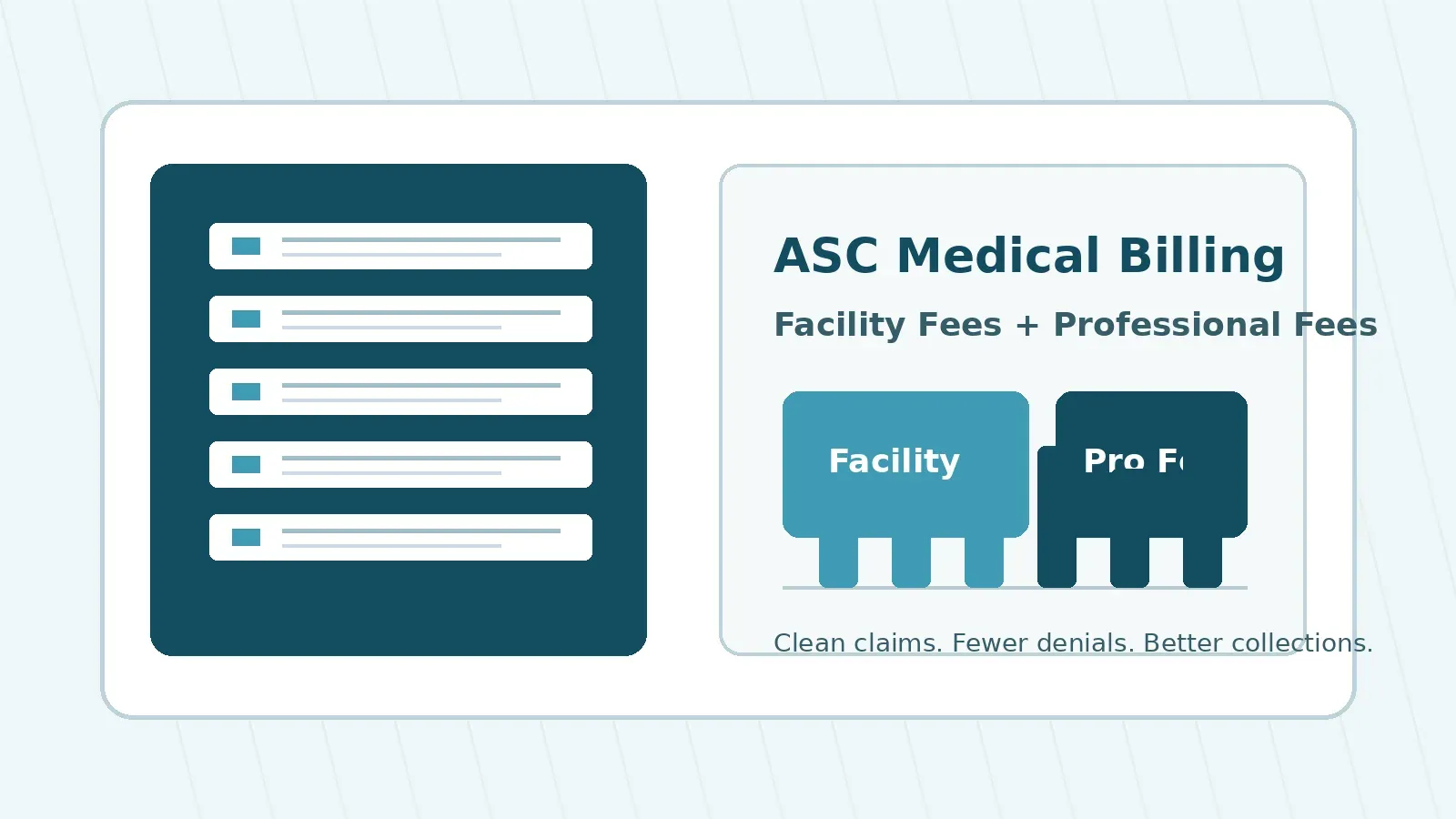
Facility Fees vs Professional Fees: The Core Difference
The facility fee and the professional fee represent two different parts of the same surgical encounter. Keeping them distinct is essential for clean claims and accurate reimbursement.
| Billing Component | Who Bills It | What It Covers | Why It Matters |
|---|---|---|---|
| Facility fee | Ambulatory surgery center | Operating room, recovery area, nursing support, equipment, routine supplies, and facility resources | Drives ASC revenue and depends on correct procedure eligibility, coding, documentation, and payer contract rules |
| Professional fee | Surgeon, anesthesiologist, or other provider | Clinical work performed by the treating professional | Must align with the procedure performed but is billed separately under the provider’s NPI |
In practical terms, the ASC is not billing for the surgeon’s work. It is billing for the site of service and the resources used during the outpatient procedure. The surgeon, anesthesiologist, and other professionals bill for their own services based on their role in the case.
This separation creates several operational risks. If registration data differs between the two claims, the payer may reject or delay one side. If the procedure code on the professional claim does not align with the facility claim, the payer may request records. If authorization was obtained for the physician but not the facility, the ASC may face a preventable denial.
Strong ASC billing workflows connect both sides without blending them. The billing team should confirm patient demographics, payer eligibility, authorization requirements, procedure codes, diagnosis support, place of service details, and documentation consistency before claims go out.
How Medicare ASC Reimbursement Works
Medicare ASC reimbursement follows rules that are specific to the ambulatory surgery center setting. CMS states that the ASC payment is for facility costs only, and that the physician or other treating professional is paid separately under the Medicare Physician Fee Schedule for professional services.
That distinction matters because Medicare only pays ASCs for covered surgical procedures that meet ASC payment requirements. A case that is clinically appropriate for an outpatient setting still needs to be billable under the applicable ASC rules. Billing teams must verify whether the procedure is covered in the ASC setting before the date of service whenever possible.
Covered procedure list
Medicare maintains an ASC covered procedures list. If a procedure is not payable in the ASC setting, the facility claim can be denied even when the surgery was performed successfully and documented correctly. This is why pre-service verification should include more than basic eligibility. It should confirm whether the planned procedure can be reimbursed for the ASC.
Packaged and separately payable items
Many items used during an ASC case are packaged into the procedure payment. Routine supplies, facility overhead, and many related services are not separately reimbursed. Other items may be separately payable depending on the payer, the contract, and the documentation. Implant billing is a common example where centers lose revenue because the operative report, invoice, charge ticket, and payer rules are not aligned.
Quality and compliance considerations
ASC billing also intersects with quality reporting, medical necessity standards, payer medical policies, and audit risk. Clean reimbursement depends on showing that the procedure was covered, medically necessary, properly authorized, correctly coded, and supported by documentation in the record.
Why ASC Billing Is More Complex Than Physician Billing
Physician billing is complex, but ASC billing adds layers that many office-based billing teams are not built to manage. The billing team must understand surgical scheduling, facility charge capture, payer contract modeling, implant cost recovery, multiple procedure rules, and payer-specific edits.
Common complexity drivers include:
- Separate claims for the same encounter: Facility and professional claims must be coordinated without being duplicated.
- Procedure eligibility rules: Not every outpatient procedure is payable in an ASC setting.
- Prior authorization differences: The physician, facility, and anesthesia components may have different authorization requirements. Credentialing and enrollment details also need to stay current, which is why many practices pair ASC billing workflows with medical credentialing support.
- Implant and supply documentation: Missing invoices or incomplete operative notes can cause underpayment.
- Multiple procedure logic: Secondary procedures may be discounted or bundled depending on payer rules.
- Contract variation: Commercial payer reimbursement may be based on case rates, percent of charges, percent of Medicare, carve-outs, or other negotiated terms.
When ASCs rely on generic billing workflows, they often discover problems only after denials rise or cash slows down. A better approach is to build the revenue cycle around the ASC case from the beginning: scheduling, authorization, documentation, coding, claim submission, payment posting, and denial follow-up.
What Information Is Needed Before an ASC Claim Goes Out?
A clean ASC claim starts before the patient arrives. The billing team should have a complete case file that supports the procedure, the payer requirements, and the facility charge. Waiting until after the denial arrives turns preventable issues into accounts receivable work.
At a minimum, every ASC case should include:
- Accurate patient demographics and insurance information
- Eligibility verification for the date of service
- Prior authorization confirmation, including facility-specific requirements
- Procedure codes and diagnosis codes that support medical necessity
- Surgeon documentation and operative report details
- Implant logs, invoices, and supply documentation when applicable
- Anesthesia records when relevant to payer review
- Signed consent and required administrative documentation
- Payer contract terms or fee schedule references for expected reimbursement
This documentation does more than support initial claim submission. It also supports underpayment review, appeals, and audit response. If the payer pays less than expected, the billing team needs enough detail to determine whether the payment is correct or whether the claim should be appealed.
See how AMS Solutions supports medical billing and revenue cycle management for specialty practices.
Common ASC Medical Billing Denials
ASC denials tend to follow predictable patterns. The challenge is that each denial type points to a different operational fix. A high denial rate is rarely just a billing department problem. It often reflects breakdowns across scheduling, front desk intake, authorization, coding, documentation, and payer follow-up.
Authorization denials
Authorization denials happen when the payer required approval before the procedure and the authorization was missing, incomplete, expired, or tied to the wrong provider or facility. ASCs should verify whether the authorization covers the facility component, not just the surgeon.
Medical necessity denials
Medical necessity denials occur when diagnosis codes, documentation, or payer policy requirements do not support the procedure. These denials are easier to prevent when clinical documentation requirements are checked before the case is performed.
Coding and modifier denials
ASC claims often require careful modifier use for laterality, discontinued procedures, multiple procedures, and distinct procedural services. Incorrect modifier selection can trigger denial, downcoding, or payment delay.
Bundling and packaging denials
Some supplies, drugs, and services are packaged into the facility payment. Billing them separately when the payer considers them bundled may cause denials or recoupment risk. The opposite problem also matters: failing to bill separately payable items when allowed can leave revenue uncollected.
Coordination and demographic denials
Simple data issues still create expensive delays. Incorrect member IDs, outdated coverage, wrong payer selection, coordination of benefits problems, and mismatched patient information can stop an otherwise payable claim.
How ASCs Can Improve Collections
Improving ASC collections requires more than working denials faster. The goal is to prevent avoidable denials, catch underpayments quickly, and create visibility into the exact points where revenue is leaking.
1. Build a pre-service verification checklist
Every scheduled case should go through eligibility, benefits, authorization, covered procedure, medical necessity, and patient responsibility checks. This checklist should be completed before the date of service whenever possible.
2. Reconcile charge capture against the operative record
The final claim should reflect what actually happened in the operating room. Case logs, implant records, supply documentation, and the operative report should match the billed codes and charges.
3. Track denials by root cause
Denial reports are only useful if they show why claims are failing. Separate authorization issues from coding issues, payer policy issues, demographic errors, timely filing problems, and underpayment disputes. Then assign each category to the workflow owner who can prevent it.
4. Review payments against contract terms
Payment posting should not be limited to entering checks. ASC teams should compare allowed amounts to payer contracts, case rates, carve-outs, implant terms, and expected reimbursement. Underpayments can hide inside high claim volume when no one is reviewing variances.
5. Use specialty billing expertise
ASC billing requires knowledge of facility claims, payer rules, specialty procedures, and reimbursement strategy. A billing partner that understands surgery center workflows can help centers reduce avoidable rework and focus staff time on higher-value tasks.
AMS Solutions has supported healthcare practices since 1992 with medical billing, collections and A/R management, credentialing, and practice management consulting. The company works with practices across the country and provides dedicated account representatives instead of an impersonal call center model.
When Should an ASC Consider Outsourcing Billing?
An ASC should consider outsourcing billing when internal teams are spending more time reacting to denials than preventing them, when collections are inconsistent, or when leadership lacks clear visibility into payer performance. Outsourcing is not just about reducing administrative work. It is about bringing structure, expertise, and accountability to the entire revenue cycle.
Signs that an ASC may need outside billing support include:
- Denials are rising or appeals are not being worked consistently
- Days in accounts receivable are increasing
- Implant payments or carve-outs are difficult to track
- Staff turnover is disrupting claim follow-up
- Payer contracts are not being checked against actual payments
- Leadership does not receive clear reporting on denial trends and collection performance
- The center is adding new specialties or higher-complexity cases
For many centers, the right billing partner is not simply a vendor that submits claims. It is a revenue cycle partner that understands how surgical documentation, payer contracts, authorization workflows, and collection follow-up work together.
Explore AMS Solutions’ practice management consulting services for additional revenue cycle support.
ASC Medical Billing Checklist
Use this checklist to evaluate whether your ASC billing process has the controls needed to protect revenue:
- Confirm procedure eligibility for the ASC setting before service
- Verify facility-specific authorization requirements
- Confirm benefits, coverage, and patient responsibility
- Match procedure codes to operative documentation
- Document implants, supplies, invoices, and payer requirements
- Apply modifiers consistently and according to payer rules
- Submit facility and professional claims separately and accurately
- Post payments against expected reimbursement
- Appeal underpayments and preventable denials quickly
- Report denial trends by root cause each month
If any of these steps are inconsistent, the center may be losing revenue even when claims appear to be moving through the system.
FAQ About ASC Medical Billing
What is the difference between ASC facility billing and physician billing?
ASC facility billing covers the surgery center’s resources, such as operating room time, nursing support, equipment, recovery area use, and routine supplies. Physician billing covers the professional service performed by the surgeon, anesthesiologist, or other treating provider. The two claims are related to the same encounter but are submitted separately.
Do ASCs bill the same way as hospitals?
No. ASCs have their own facility billing rules and reimbursement structure. Hospital outpatient departments and ambulatory surgery centers may perform similar procedures, but payer rules, payment rates, forms, and contract terms can differ significantly.
Why do ASC claims get denied?
ASC claims are commonly denied because of missing authorization, procedure eligibility issues, medical necessity problems, incorrect modifiers, demographic errors, bundling rules, or incomplete documentation for implants and supplies.
Can AMS Solutions help with ASC billing?
Yes. AMS Solutions provides medical billing and revenue cycle management support for healthcare practices and specialty providers. The team offers dedicated account representatives, transparent percentage-based pricing, and experience that dates back to 1992.
Bring More Control to Your ASC Revenue Cycle
ASC medical billing requires precision at every step. Facility and professional fees must be separated correctly, payer rules must be verified before claims go out, and every payment should be checked against expected reimbursement. When those controls are missing, revenue loss can look like normal accounts receivable activity until the financial impact becomes obvious.
AMS Solutions helps healthcare organizations strengthen billing operations with experienced revenue cycle support. If your surgery center is dealing with denials, underpayments, slow collections, or limited reporting, a focused billing review can show where revenue is being delayed and what to fix first.
Contact AMS Solutions to discuss ASC medical billing support.
