
Medical Billing for Ambulatory Surgery Centers: A Complete Guide
If your ASC is struggling with denied claims, underpayments, or a slow ambulatory surgery center revenue cycle, the problem almost always traces back to one source: the unique complexity of ambulatory surgery center billing. Many administrators assume billing processes from a physician’s office will work, but that’s a recipe for financial trouble. ASCs operate under entirely different rules. We’re talking about facility fees, device pass-throughs, and multiple procedure discounting. Getting these details wrong directly impacts your ambulatory surgery center revenue integrity. This guide clarifies these critical distinctions and provides actionable steps to secure the full reimbursement you’ve earned.
Contact AMS Solutions for a free ASC billing assessment and discover how specialized billing expertise can maximize your surgery center’s revenue.
If your ASC is struggling with denied claims, underpayments, or lengthy accounts receivable cycles, the issue almost always traces back to billing complexity that demands specialized expertise. This guide breaks down the critical components of ASC billing so your team can identify gaps and make informed decisions about your revenue cycle.
ASC vs. Physician Billing: What’s the Difference?
ASC billing operates under distinct fee schedules, coding requirements, and coverage rules that set it apart from standard physician practice billing. Many ASC administrators assume that billing processes used for physician practices translate directly to a surgery center environment. They do not, and the financial consequences of that assumption compound quickly.
The two primary billing streams within an ASC are:
- Facility billing: the ASC submits claims for the use of the facility, equipment, nursing staff, and routine supplies under its own National Provider Identifier (NPI).
- Physician billing: the operating surgeon, anesthesiologist, or other providers bill separately for their professional services under their own NPI.
This dual-billing structure means that coding errors or documentation gaps on either side can trigger claim denials, underpayments, or compliance exposure. Understanding how each element works, and how they interact, is the foundation of effective ASC medical billing.
For a deeper look at how Medicare and commercial payer coverage rules affect your claims, see AMS Solutions’ guide to navigating Medicare and Medicaid billing guidelines.
State-specific regulations also play a significant role in ASC reimbursement. For practices operating in specific regions, understanding local requirements is essential. Learn more about medical billing services in Texas and stay current with Florida ASC billing requirements.
What’s Covered by the ASC Facility Fee?
Facility fees are the cornerstone of ASC revenue. When Medicare or a commercial payer reimburses an ASC, the facility fee covers the overhead costs of performing a procedure: operating room time, nursing staff, disposable supplies, equipment depreciation, and routine drugs.
Included Services and Supplies
Think of the facility fee as the comprehensive charge for the resources your patient uses during their procedure at the center. This single fee bundles together the essential operational costs. It covers the invaluable services provided by your nursing staff and technicians who assist during the surgery and recovery. The fee also includes the use of the facility itself—from the operating and recovery rooms to the patient prep areas. Finally, it accounts for the standard supplies and equipment used during the procedure, such as surgical dressings, splints, casts, and other routine materials. This bundled payment is designed to simplify billing for the core services an ASC provides for a given covered surgical procedure.
Separately Billable Excluded Services
It’s just as important to know what the facility fee *doesn’t* cover. The most significant exclusion is the professional fees for the physicians. The surgeon, anesthesiologist, and any other consulting physicians will bill for their services separately under their own provider numbers. Additionally, any durable medical equipment (DME) that the patient takes home, like crutches or a walker, is billed separately. Certain high-cost items, such as specific implants with pass-through status or brachytherapy sources, are also excluded from the standard facility fee and have their own billing rules. Managing these separate billing streams is a complex task that requires precision to ensure every component of care is reimbursed correctly, which is a key focus of expert medical billing services.
Getting Paid: Medicare’s APC System Explained
Medicare reimburses ASC facility services using a payment system tied to Ambulatory Payment Classifications (APCs). Each covered procedure falls into an APC group, and Medicare pays a single packaged rate for that group. The ASC payment rate is set at approximately 57 to 60% of the Hospital Outpatient Prospective Payment System (HOPPS) rate, a built-in cost differential that makes proper documentation even more important for maximizing what you legitimately collect.
Key points for ASC facility fee billing under Medicare:
- Only procedures on Medicare’s ASC-covered surgical procedures list are reimbursable as facility services. Procedures not on this list must be carefully evaluated for site-of-service appropriateness.
- Packaged services such as anesthesia, most drugs, and certain supplies are bundled into the APC rate and cannot be billed separately.
- Correct procedure code selection and appropriate modifier usage are critical. Errors here create underpayments or outright denials.
- ASC Quality Reporting (ASCQR) program compliance affects payment; failure to report quality measures results in a 2.0 percentage point reduction in annual fee schedule updates.
Understanding the ASC Payment System vs. Hospital APCs
While both Ambulatory Surgery Centers (ASCs) and Hospital Outpatient Departments (HOPDs) use a system based on Ambulatory Payment Classifications (APCs), their payment methodologies are not the same. This is a critical distinction that directly impacts an ASC’s revenue and often causes confusion. The rules governing how much you get paid and for what services differ significantly between the two settings. Understanding how ASC rates are calculated and how to interpret Medicare’s specific payment rules is fundamental to your financial success. It’s the difference between a thriving center and one that constantly struggles with cash flow due to underpayments and denials.
How ASC Rates Are Calculated
Medicare sets ASC facility payment rates based on the Hospital Outpatient Prospective Payment System (HOPPS), but with a major adjustment. An ASC is typically reimbursed at a rate that is about 57% to 60% of what a hospital outpatient department receives for the exact same procedure. This built-in cost differential is Medicare’s way of recognizing the lower overhead costs of an ASC. However, it also means your margin for error is razor-thin. Flawless documentation and coding are not just best practices; they are essential for collecting every dollar you are rightfully owed. This is where specialized ASC billing expertise becomes invaluable in protecting your revenue cycle.
Decoding Medicare’s Payment Status Indicators
To determine how a procedure will be paid, Medicare uses a system of codes called payment status indicators. Both ASCs and hospital APCs have their own sets of these indicators, and they are not interchangeable. These single-letter codes are attached to every CPT code and tell your billing team whether a service is payable, packaged into another service, or not covered in your specific facility setting. For example, an indicator might signal that a procedure is payable in an ASC, while a different indicator for the same CPT code might apply in a hospital setting. Misinterpreting these payment status indicators is a common source of claim denials, making them a crucial piece of the billing puzzle.
Managing Commercial Payer Facility Fee Contracts
Commercial insurers negotiate ASC facility fee rates directly with your center, typically as a percentage of billed charges, a percentage of Medicare rates, or a case rate. These contracts vary significantly by payer and by procedure type. Many ASCs are chronically underpaid simply because their billing team submits claims without verifying that the payment received actually matches the contracted rate.
Effective ASC billing requires a payment variance review process: every remittance should be checked against the applicable contract to catch underpayments before they become uncollectable write-offs.
Mastering ASC Billing Codes and Modifiers
Getting paid correctly in an ASC environment often comes down to the details. While selecting the right CPT code for the procedure is the first step, it’s the claim forms and modifiers that tell the complete story. These elements provide critical context that payers use to process and price your claims. A single misplaced code or incorrect modifier can lead to a denial, underpayment, or a lengthy appeal process. Understanding these nuances is fundamental to maintaining a healthy revenue cycle and ensuring you are compensated accurately for the care you provide.
Using the Correct Claim Form and Place of Service Code
Before a payer even looks at your procedure codes, they check the basics: are you using the right form and did you identify the correct place of service? Getting these foundational elements right is non-negotiable. It’s the first gate your claim must pass through, and errors here will stop it in its tracks, leading to immediate rejections that delay payment and create unnecessary administrative work. This simple check is the first line of defense for clean claims, setting the stage for the rest of the billing process.
Independent vs. Hospital-Based ASCs: UB-04 vs. CMS-1500
The type of claim form you use depends on your ASC’s structure. Hospital-based or hospital-affiliated ASCs must submit their facility claims on the UB-04 form (also known as the CMS-1450), which is designed for institutional claims. In contrast, independent or freestanding ASCs should use the CMS-1500 form for their facility fee billing. This is the same form used for professional physician billing, but in this context, it’s for the ASC’s facility charges. Using the wrong form is a guaranteed rejection, so it’s essential your billing team knows which one applies to your center.
The Importance of Place of Service Code 24
Place of Service (POS) codes tell a payer where a medical service was performed. For an Ambulatory Surgery Center, the correct code is always 24. This specific code signals to the payer that the services were rendered in an ASC setting, which triggers the appropriate ASC-specific fee schedules and payment rules. If your team mistakenly uses a code for an office (POS 11) or a hospital outpatient department (POS 22), the claim will either be denied or paid incorrectly. Consistently using POS code 24 is a simple but critical step for accurate billing.
Essential Modifiers for Accurate Reimbursement
Modifiers are two-character codes that you append to a CPT code to provide additional information about a procedure. Think of them as essential adjectives in your billing narrative; they clarify how, why, or where a service was altered from its typical description without changing the core definition of the code. For ASCs, using modifiers correctly is not just good practice—it’s a direct line to accurate payment. They are crucial for explaining situations like discontinued procedures, the use of facility-provided equipment, or circumstances involving costly implants. Failing to apply the right modifier, or using the wrong one, can cause payers to misinterpret the service provided, leading to underpayments or denials that require time-consuming appeals to fix.
Modifiers for Terminated Procedures: 73 and 74
When a surgery is stopped unexpectedly, these modifiers explain exactly when the termination occurred, which directly impacts your payment. Use Modifier 73 if the procedure was canceled before anesthesia was administered to the patient. In this case, Medicare typically pays 50% of the allowed amount. If the procedure was stopped after anesthesia was induced, you should use Modifier 74. This allows for the full payment of the facility fee, as significant resources have already been committed. This distinction is critical for capturing appropriate revenue for resources already used and preventing a total loss on the claim.
Device-Related Modifiers: FB
This modifier is all about transparency with device costs and is crucial for compliance. You must append Modifier FB to a procedure code when an implantable device was provided to your ASC at no cost or with a significant credit of 50% or more. This modifier clearly communicates to the payer that they should not reimburse for the device itself, only for the procedure. Using it correctly ensures billing accuracy, prevents overpayment issues, and helps your facility avoid the scrutiny of a potential audit for being paid for items you didn’t purchase.
Technical Component Modifier: TC
The TC modifier is essential for services that have both a technical and a professional component, like many diagnostic imaging procedures. It clearly separates the facility’s work from the physician’s interpretation. When your ASC submits a claim for a service like an X-ray, you must use the TC modifier to indicate you are billing for the technical part—the use of your equipment, supplies, and staff. The radiologist who reads the X-ray will then bill separately for their professional service using Modifier 26. Using the TC modifier correctly prevents your claim from being denied as a duplicate of the physician’s claim.
Modifiers to Avoid in ASC Billing
Just as important as knowing which modifiers to use is knowing which ones to avoid. Certain modifiers are reserved exclusively for professional (physician) billing and will cause an automatic denial if used on an ASC facility claim. For example, Modifier 26, which denotes the professional component of a service, should never appear on a facility claim. Similarly, Modifier 50 for bilateral procedures is not used in ASC billing; instead, ASCs must report the procedure on two separate lines or follow payer-specific guidelines. These kinds of errors are common but completely avoidable with the right expertise. This is where having a dedicated partner can make all the difference in your revenue cycle. The complexities of ASC coding are exactly why many centers trust their financial health to specialized medical billing services. An expert team ensures these details are handled correctly every time, preventing denials before they happen.
How to Bill for Implants in Your ASC
Implantable devices such as joint prostheses, spinal hardware, cardiac devices, and cochlear implants represent one of the most significant cost variables in outpatient surgery. For ASCs, recovering the actual cost of these implants is critical to financial viability, especially in orthopedic, spine, and cardiac cases.
Getting Reimbursed: Medicare’s Pass-Through Rules for Implants
Under Medicare, certain high-cost implants qualify for “pass-through” status, meaning that the implant cost is paid separately from the standard APC facility fee rather than being bundled into it. Pass-through status is temporary (typically two to three years) and is intended to allow cost data to accumulate before the device cost is incorporated into the base APC rate.
To bill an implant pass-through correctly:
- Use the appropriate HCPCS pass-through device code (C-codes for hospital outpatient; transitional pass-through for ASCs has different qualifications).
- Document the device’s invoice cost; Medicare offsets the pass-through payment by any portion already included in the APC rate.
- Ensure your ASC’s cost report accurately reflects device acquisition costs.
Pass-through payments for devices are more limited for ASCs than for hospital outpatient departments. Many devices reimbursed as pass-throughs in the HOPPS system are simply bundled into the ASC rate without separate payment. Knowing which payers offer any form of implant carve-out, and negotiating this into your commercial contracts, is one of the highest-value billing and contracting strategies available to surgical centers.
Billing Implants to Commercial Payers: What You Need to Know
Commercial payer contracts vary widely on implant reimbursement. Some payers allow you to bill implants at invoice cost plus a markup percentage. Others apply a fee schedule rate regardless of actual cost. Many require prior authorization for high-cost devices and will deny the implant claim, or the entire case, if authorization was not secured in advance.
Best practices for implant billing include:
- Maintain an implant log documenting the device name, model, lot number, invoice cost, and implanting surgeon for every case.
- Review each payer’s implant policy before scheduling cases involving high-cost devices.
- Negotiate implant carve-outs or case rates that account for implant variability during contract renewals.
- Submit implant invoices with claims when required by payer policy.
Talk to AMS Solutions about maximizing your implant reimbursement recovery.
How Does Multiple Procedure Discounting Affect ASC Billing?
When two or more procedures are performed during the same surgical session, Medicare and most commercial payers apply multiple procedure discounting rules. Understanding how this works, and how to code it correctly, is one of the more nuanced aspects of ASC medical billing.
Applying Medicare’s Multiple Procedure Rules
Under Medicare’s ASC payment system, when multiple covered procedures are performed in the same operative session:
- The highest-valued procedure is paid at 100% of the applicable APC rate.
- Each additional procedure in a lower or equal APC group is paid at 50% of the full APC rate.
- Procedures with the same APC assignment are all paid at 50% after the first.
This discounting policy significantly affects reimbursement calculations when planning surgical scheduling and coding strategy. The sequencing of procedure codes on the claim form matters: place the highest-reimbursed procedure first. Swapping the order can inadvertently reduce payment when procedures share close APC values.
The Right Way to Bill for Bilateral Procedures
Bilateral procedures add another layer. When the same procedure is performed on both sides of the body during the same session, Medicare typically pays 150% of the single procedure rate (rather than 200%). Use modifier -50 (bilateral procedure) correctly, and verify that your billing software applies this logic rather than doubling the standard rate, which would generate an overpayment and potential compliance exposure.
Working with Add-On Codes and Bundling Edits
Medicare’s National Correct Coding Initiative (NCCI) edits and the Outpatient Code Editor (OCE) govern which procedure codes can be billed together and which are considered bundled. Unbundling, meaning billing separately for a component service that is part of a larger procedure code, is a compliance risk that can result in claim denials, audits, and overpayment demands.
Your billing team must regularly update their knowledge of NCCI edits and apply appropriate modifiers (such as modifier -59 for distinct procedural services) when two procedures are genuinely separate and distinct, documented in the operative report, and payable together under payer policy.
Top Challenges in Ambulatory Surgery Center Billing
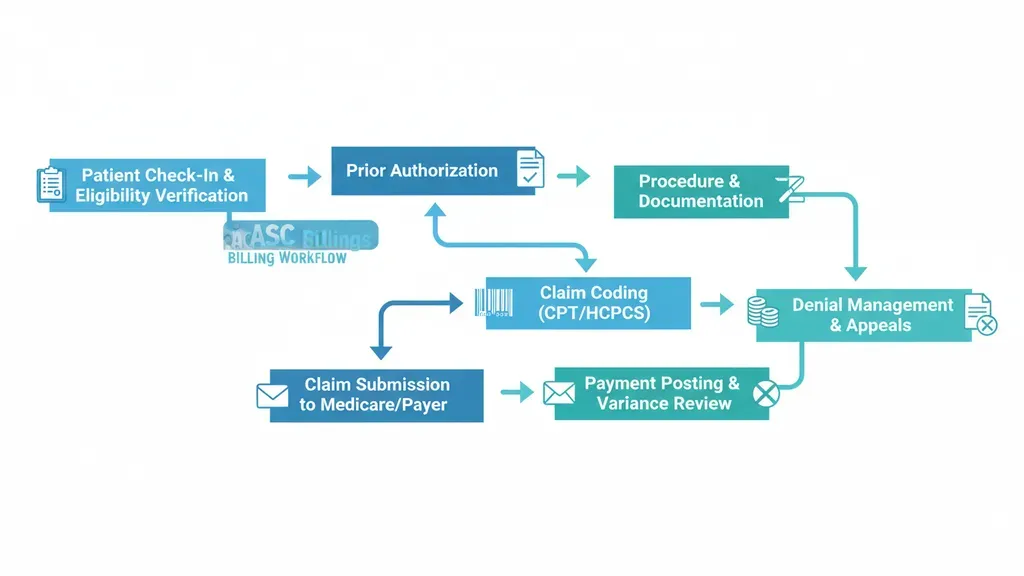
Even experienced ASC teams encounter billing obstacles that erode revenue. The most common issues include:
- Incomplete documentation: Operative reports that do not support the billed procedure codes, or that fail to distinguish between bilateral and unilateral services, are a leading cause of denials and downcoding.
- Authorization gaps: Failing to obtain prior authorization for procedures, implants, or out-of-network services creates denials that are difficult or impossible to reverse after the fact.
- Inaccurate patient eligibility verification: Verifying benefits before the procedure is performed prevents situations where the patient’s coverage does not include ASC facility services.
- Missed payer deadlines: Commercial payers have strict timely filing limits, often 90 days from the date of service. Claims submitted after the deadline are typically denied with no right of appeal.
- Incorrect modifier use: Missing or incorrect modifiers on high-complexity cases, bilateral procedures, and multiple surgeries cause systematic underpayments that compound over time.
- Credentialing lapses: If a surgeon or anesthesiologist performs a case before their credentialing with the relevant payer is complete, the facility claim may also be impacted. Keeping provider credentialing current is essential to uninterrupted billing.
- Accounts receivable aging: Without active medical accounts receivable management, denial backlogs and aging balances erode collections over time.
ASC vs. Hospital Outpatient: Key Billing Differences
| Factor | ASC Billing | Hospital Outpatient Billing |
|---|---|---|
| Fee Schedule | ASC-specific APC rates (57-60% of HOPPS) | Hospital Outpatient PPS (HOPPS) rates |
| Claim Form | CMS-1500 with ASC NPI | UB-04 (institutional claim) |
| Implant Pass-Through | Limited; most bundled into APC | Broader pass-through eligibility |
| Covered Procedures | Medicare-approved ASC procedure list only | Most outpatient procedures covered |
| Quality Reporting | ASCQR program (2% penalty for non-compliance) | OPPS quality reporting requirements |
The Financial Advantage of ASCs
Ambulatory surgery centers have reshaped the landscape of outpatient care by providing high-quality procedures at a much lower cost than hospital outpatient departments (HOPDs). This financial advantage stems from an ASC’s specialized, efficient operating model, which carries less overhead than a large hospital system. For patients and payers alike, this translates into significant savings without compromising the quality of care. However, this leaner financial structure means that every dollar of revenue is critical. For an ASC to remain profitable, its billing process must be flawless. Capturing the full, correct reimbursement for every service provided is not just a goal; it’s essential for survival and growth in a competitive healthcare market.
The Rise of Site-Neutral Payment Policies
One of the biggest financial hurdles for ASCs is the disparity in payment rates compared to HOPDs. For the exact same procedure, ASCs often receive only 50% to 60% of what HOPDs get. Specifically, Medicare pays about 53% of the HOPD rate when care is provided in an ASC. This gap has fueled a long-standing debate around “site-neutral” payment policies, which advocate for paying the same rate for a service regardless of where it’s performed. Until these policies become widespread, ASCs must operate within this challenging reimbursement environment. This makes expert medical billing services absolutely critical. A team that understands how to maximize collections under these compressed fee schedules can make the difference between a struggling center and a thriving one.
When an ASC Bills as an HOPD: The 35-Mile Rule
There is a notable exception to the standard ASC payment model. In specific situations, an ASC can be considered an HOPD for billing purposes if it’s within 35 miles of a hospital and shares the hospital’s financial and administrative setup. This “35-mile rule” allows certain hospital-affiliated surgery centers to bill under the more favorable HOPD fee schedule. This arrangement requires careful structuring and a deep understanding of regulatory requirements to ensure compliance. Setting up and managing this type of integrated system involves complex operational decisions that go beyond just billing. It often requires specialized practice management consulting to align the financial, administrative, and clinical components of both the hospital and the ASC correctly.
Better Payer Contracts for a Healthier Revenue Cycle
Your ASC’s reimbursement potential is largely determined before a single claim is submitted. It is set by the fee schedules and contract terms you have negotiated with each payer. Many ASCs leave significant revenue on the table by accepting initial contract offers without negotiation or by failing to renegotiate as procedure volumes and costs evolve.
Areas to evaluate in your payer contracts:
- Are your rates pegged to a percentage of Medicare, and if so, is that percentage competitive with market rates in your region?
- Does the contract include carve-outs for high-cost implants or complex procedures?
- Are there escalator clauses that automatically adjust rates annually?
- What is the payer’s policy on implant billing, bilateral procedures, and multiple procedure discounting?
Bringing data to contract negotiations, using case mix reports, cost-per-procedure analysis, and denial rate breakdowns, gives your ASC leverage and demonstrates sophisticated financial management to payers.
Maintaining ASC Billing Integrity and Compliance
ASCs operate under close scrutiny from Medicare, state regulators, and commercial payers. The Office of Inspector General (OIG) regularly includes ASC billing practices in its work plan, with particular attention to upcoding, implant billing, and unbundling. A robust compliance program that includes regular internal audits, staff training, and documentation review is not optional; it is a financial and legal necessity.
Key compliance safeguards for ASCs include:
- Regular coding audits comparing operative reports to billed procedure codes
- Annual review of NCCI edits and payment system updates
- Clear policies on medical necessity documentation for scheduled procedures
- Prompt self-reporting and repayment processes when billing errors are identified
Schedule a free compliance and billing review with AMS Solutions today.
Key Medicare Compliance Rules
Beyond the complexities of coding and modifiers, Medicare has several fundamental compliance rules that every ASC must follow to ensure proper payment and avoid penalties. These aren’t just suggestions; they are foundational requirements for participation in the Medicare program. Misunderstanding these rules can lead to automatic claim denials, takebacks during audits, and significant compliance risk. Knowing these core principles inside and out is just as important as getting the CPT codes right, as they dictate who you can bill and how much you can expect to be paid for your services.
Mandatory Acceptance of Medicare Assignment
One of the most critical rules for any ASC participating in Medicare is the mandatory acceptance of assignment. This means that for any covered surgical procedure, your center must agree to accept the Medicare-approved amount as payment in full. As noted by Medicare contractor Novitas Solutions, “ASCs must always agree to accept the payment amount Medicare sets for their services.” You cannot bill the patient for the difference between your standard charge and the Medicare allowable amount, a practice known as balance billing. Your only recourse for patient collection is for applicable deductibles and coinsurance, making it essential that your front-office team accurately verifies and communicates these responsibilities to the patient before the procedure.
Billing for Patients in a Skilled Nursing Facility (SNF)
Another specific and often misunderstood rule involves patients who are in the middle of a skilled nursing facility stay. According to Medicare policy, if a patient is in an SNF under a Part A stay, any services provided by an ASC during that time are considered part of the SNF’s consolidated billing. This means the ASC cannot submit a separate claim to Medicare Part B for the facility fee. As the Medicare contractor Noridian explains, these services “are not paid as a Part B claim.” Instead, the ASC must make arrangements to be paid by the SNF. Failing to check a patient’s SNF status before a procedure is a common cause of denials that are nearly impossible to appeal successfully.
Essential CMS Resources for ASCs
Staying on top of the ever-changing landscape of ASC billing requires constant learning and access to reliable information. Fortunately, the Centers for Medicare & Medicaid Services (CMS) provides several key resources designed to help ASCs remain compliant and informed. Instead of waiting for denials to learn about a new rule, your team can proactively monitor these official channels to anticipate changes, understand payment methodologies, and find answers to complex billing questions. Integrating these resources into your regular operational workflow is a hallmark of a well-managed and financially resilient surgery center.
Leveraging the CMS ASC Center
CMS maintains a dedicated online portal called the “ASC Center,” which serves as a primary source of information for surgery centers. This resource acts as a “one-stop shop for information about Medicare Fee-for-Service ASCs.” On this site, your team can find the annual updates to payment rates, the list of ASC-covered procedures, guidelines for the ASC Quality Reporting (ASCQR) Program, and links to relevant regulations and transmittals. Bookmarking this page and checking it regularly is one of the most effective ways to stay current on federal policies that directly impact your revenue cycle and operational requirements.
Staying Current with Annual Proposed Rules
Each year, CMS releases proposed and final rules that outline upcoming changes to the ASC payment system. These documents are your roadmap to the future of ASC reimbursement. For example, CMS has already published proposed rules for 2026 that could alter how much Medicare pays for both hospital outpatient and ASC services. By reviewing these documents as soon as they are released, your ASC can anticipate shifts in payment rates for your most common procedures, learn about new device pass-through policies, and understand changes to quality reporting measures. This proactive approach allows you to adjust financial forecasts and even provide feedback to CMS during the public comment period, giving you a voice in the policymaking process.
Why Specialized ASC Billing Expertise Matters
The complexity of ASC billing, spanning facility fee structures, implant cost recovery, multiple procedure rules, and stringent compliance requirements, demands billing professionals who specialize in the surgical center environment. A generalist billing team, however skilled at physician practice billing, may lack the specific knowledge needed to optimize ASC revenue and maintain compliance.
Outsourcing your ASC’s medical billing to a dedicated revenue cycle partner delivers several advantages:
- Access to specialists who stay current with Medicare payment system updates, NCCI edits, and payer policy changes as their primary focus
- Systematic denial management and appeals, with every denial worked, not just the easy ones
- Payment variance reviews that catch payer underpayments before the appeal window closes
- Scalable capacity that accommodates procedure volume growth without proportional staffing increases
- Reduced internal overhead and elimination of staff turnover risk in a tight labor market for certified coders
For ASCs that also perform high volumes of orthopedic or musculoskeletal procedures, coordinating facility billing with your surgeons’ orthopedic medical billing ensures consistency and reduces the risk of conflicting claims.
Improve Your ASC Revenue Cycle with AMS Solutions
AMS Solutions has been delivering specialized medical billing and revenue cycle management services since 1992. Founded by physicians, we understand the operational and financial pressures that surgical facilities face. Our team includes billing professionals with deep expertise in ASC facility billing, implant cost recovery, and complex surgical coding.
Our approach to ASC billing includes:
- Dedicated account representatives who know your center’s payer mix, procedure mix, and billing history
- Systematic claims scrubbing to catch coding and documentation issues before submission
- Active denial management and appeals with documented follow-up timelines
- Payment posting and variance analysis to identify payer underpayments
- Regular reporting so your leadership team has clear visibility into collection rates, denial trends, and A/R aging
We work with a wide range of surgical specialties and can integrate with your existing EHR and practice management software, including platforms like Epic EHR and eClinicalWorks. There are no setup fees, no hidden costs, just a straightforward percentage-based fee tied to your collections.
Frequently Asked Questions About ASC Billing
What CPT codes are used for ASC facility billing?
ASC facility claims use the same CPT and HCPCS procedure codes as outpatient hospital claims. The distinction is in the bill type and the payer’s ASC-specific fee schedule. The claim is submitted on a CMS-1500 form (or electronically) using the ASC’s NPI and taxonomy code, not the physician’s.
Does Medicare cover all procedures performed at an ASC?
No. Medicare only reimburses ASC facility fees for procedures on its approved covered surgical procedures list. Procedures not on this list may still be performed at the ASC, but Medicare will not pay a facility fee; only the physician professional fee applies. Staying current with the annual updates to this list is an important part of ASC revenue planning.
How are anesthesia services billed for ASC cases?
Anesthesia professional fees are billed separately by the anesthesiologist or CRNA under their own NPI on a CMS-1500. The ASC facility claim does not include anesthesia professional services, though routine anesthesia supplies are packaged into the facility fee. If the anesthesia group is employed by or contracted with the ASC, revenue flow-through arrangements may affect how billing is structured.
How can an ASC reduce claim denials?
The most effective denial-reduction strategies include: thorough pre-authorization for all scheduled procedures and implants, accurate patient eligibility verification prior to the date of service, operative report documentation that clearly supports the billed procedure codes, and timely claims submission within each payer’s filing window. Partnering with an experienced billing team that actively manages denial trends is the single most impactful investment most ASCs can make.
Ready to Improve Your ASC’s Revenue Performance?
Medical billing for ambulatory surgery centers is too complex and too financially significant to leave to chance. Whether your center is struggling with implant reimbursement gaps, multiple procedure underpayments, or a growing A/R backlog, AMS Solutions has the specialized expertise to address the root causes and improve your collections.
We offer a free consultation and can provide a customized pricing quote in under 30 seconds. Contact our team today to learn how we can support your ASC’s revenue cycle, with no setup fees, no hidden costs, and billing professionals who work exclusively for you.
Key Takeaways
- Treat ASC billing as a specialty: Your surgery center’s financial health depends on understanding that its billing rules are completely different from a physician’s office. Key distinctions include using the correct claim form, applying Place of Service code 24, and accurately billing facility fees.
- Use modifiers and codes with precision: Correct reimbursement hinges on the details. Modifiers like 73/74 for terminated procedures or TC for technical components tell payers the full story, while avoiding physician-only modifiers prevents automatic denials and protects your revenue.
- Know your payer contracts inside and out: Your reimbursement is determined by specific payer rules for implants, multiple procedures, and covered services. Proactively managing these contracts and staying current on CMS policies is the most effective way to secure fair payment and maintain compliance.
